Fire Performance and Compliance Statement
Our Approach to Fire Compliance in the UK
At Sculptform, we specialise in providing custom-made decorative solutions tailored to the specific needs of each project. Due to the bespoke nature of most of our systems, particularly our Click-on Battens and Screens, they do not fit neatly within any harmonised standard and therefore do not require UKCA marking.
System Testing
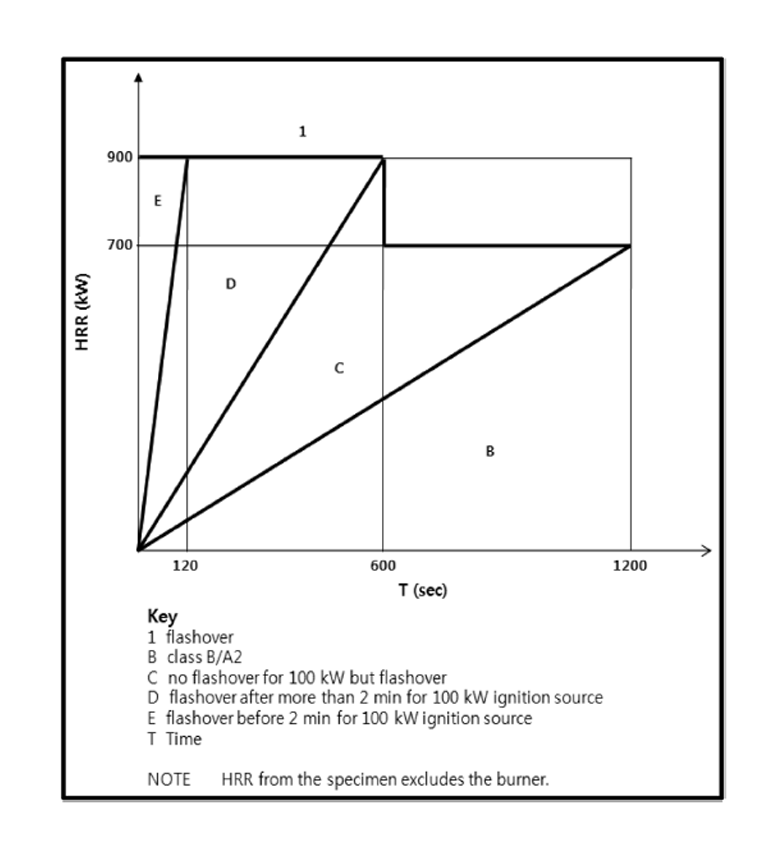
For system testing, an independent research and testing body identified the worst case Sculptform product combination and tested the full assembly to the ISO 9705 room burn standard. The testing indicates that timber with acoustic backing performs as Euroclass D, while aluminium battens with acoustic backing perform as Euroclass B (See Fig 1). These results provide guidance for system level fire performance when considering similar configurations. Download our reports below.
Fig 1: EN 13501-1 Annex A Figure A1 shows the relationship between the fire classifications and the ISO 9705 test.
Timber Projects
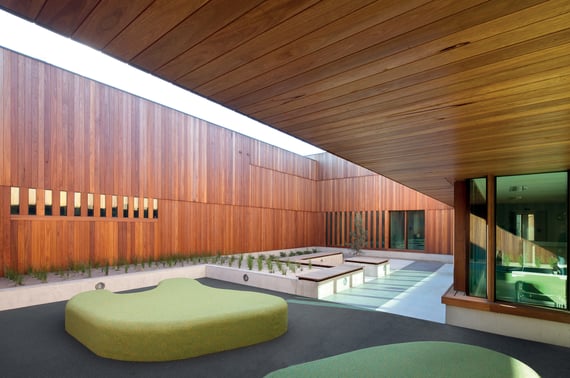
All Sculptform untreated solid timber panel product (Interior Lining Boards and Tongue & Groove Cladding) achieves Euroclass D.
Where a Euroclass B requirement applies, Sculptform facilitates an outsourced manufacturer to treat the timber—upgrading it from Class D to Class B—under the manufacturer’s certification umbrella.
We are in the process of obtaining representative system Euroclass Classification fire tests for our timber batten assemblies. These results will be available for reference as guidance only and are intended to demonstrate representative overall assembly performance. In addition, certificates of conformance will be issued directly by the outsourced timber fire treatment company for each project.
By the end of 2026, we aim to develop declarable Euroclass, EN 13501-1 classifications for a specific selection of product families, in collaboration with fire treatment partners.
Aluminium Projects
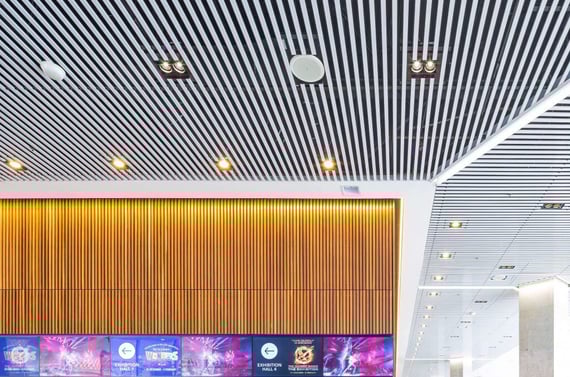
Sculptform’s aluminium systems demonstrate the following fire performance levels by finish type:
- Wood finished aluminium – Performs as Euroclass B.
- Anodised battens, screens, and cladding – Achieve Euroclass A1.
- Powder coated battens, screens, and cladding (Interpon 1000 and 2000) – Perform as Euroclass A2 s1, d0.
For batten assemblies incorporating acoustic backing, no formal Euroclass classification has been finalised; however, the ISO 9705 test report indicates that the configuration performs equivalently to Euroclass B and may be used as guidance in appropriate applications.
For aluminium based systems, we are currently preparing worst case assembly fire classification reports to provide consistent and reliable guidance for these applications.